When your furnace quits on a cold morning, furnace repair versus replacement stops being a theory and becomes a real budget decision. Most homeowners and property managers are not looking for the cheapest short-term fix or the biggest equipment upgrade. They want heat restored quickly, clear pricing, and confidence that they are not throwing money at the wrong solution.
The right choice depends on a few practical factors: the age of the system, what failed, how often it has needed service, and whether the unit is still operating safely and efficiently. In some cases, a targeted repair is the smart move. In others, replacement saves money and frustration over the next several years.
How to think about furnace repair versus replacement
A furnace should be judged by more than whether it can be made to run again today. A proper decision looks at total cost, reliability, energy use, and risk. If a repair solves an isolated problem and the rest of the system is in solid condition, repair often makes sense. If the unit is near the end of its service life and multiple components are wearing out, replacement is usually the better investment.
For many gas furnaces, the expected lifespan is around 15 to 20 years, though maintenance history, usage, and installation quality matter. In Colorado, winter demand can put extra strain on heating equipment, especially in older homes or buildings with marginal airflow and insulation. A furnace that has spent years cycling hard may still turn on, but that does not always mean it is worth keeping.
When repair usually makes sense
Repair is often the right answer when the furnace is relatively young and the issue is limited to a standard service item. Problems such as a failed ignitor, flame sensor, capacitor, thermostat, inducer motor, or control board can often be fixed without replacing the entire system.
A repair also makes sense when the unit has a strong service history. If this is the first significant issue in years, and the heat exchanger and major mechanical components are in good shape, it is reasonable to repair it and keep the system going.
Another good sign is stable operating cost. If your gas and electric bills have remained fairly consistent and the furnace has been heating the property evenly, that suggests the equipment is still doing its job efficiently enough to justify a repair.
When replacement is the smarter call
Replacement becomes more attractive when repair costs start stacking up. If the furnace has needed repeated service in the last one to three heating seasons, the problem is rarely just one part. Wear tends to spread. One repair can quickly turn into another.
Age matters too. Once a furnace gets into the 15-plus-year range, even a successful repair may only buy limited time. Parts availability can get harder. Efficiency falls behind newer models. Breakdowns become more disruptive because they happen at the worst times.
Safety is another clear line. If a furnace has a cracked heat exchanger, combustion concerns, or serious venting problems, replacement is often the responsible option. A heating system should not only run. It should run safely.
The cost question most people really mean
When people ask about furnace repair versus replacement, they are usually asking one thing: am I about to spend good money after bad?
A common rule of thumb is to compare the repair cost with the age of the furnace. If a major repair on an older system starts getting close to a meaningful percentage of replacement cost, replacement deserves serious consideration. That is not a hard formula, but it helps frame the decision.
For example, a moderate repair on a 7-year-old furnace is very different from the same repair on a 19-year-old furnace. On the newer system, the repair may restore years of dependable service. On the older one, it may only delay a replacement that is already coming.
You also have to look beyond the invoice in front of you. An older furnace may cost less to repair today but more to operate every month. A newer high-efficiency unit may cost more upfront while lowering heating bills and reducing emergency service risk. That trade-off is not identical for every property, but it is real.
Efficiency and monthly operating costs
Older furnaces can still produce heat, but many do so less efficiently than modern equipment. If your current unit is oversized, short cycling, or running with declining performance, you may be paying more than necessary to heat the same space.
This is especially relevant for larger homes, multi-unit properties, and commercial spaces where heating demand is substantial. Even a moderate efficiency gain can add up over time. If replacement also corrects sizing issues, airflow problems, or poor system matching, comfort can improve along with utility costs.
That said, efficiency alone does not automatically justify replacement. If the furnace is in decent condition and a repair is minor, you may not recover replacement cost fast enough for an upgrade to be the best financial move. This is where an honest assessment matters more than a sales pitch.
Signs your furnace is telling you it is near the end
Some systems make the choice fairly obvious. If you are hearing new banging, grinding, or rattling noises, noticing uneven heat from room to room, or seeing your furnace struggle to maintain the thermostat setting, the unit may be wearing out mechanically.
Frequent cycling is another warning sign. So is a spike in utility bills without a major change in weather or usage. If the burner operation looks irregular, the blower runs inconsistently, or the unit starts needing resets, those are signs the system is becoming less dependable.
For businesses and property managers, downtime carries an extra cost. Tenant complaints, comfort issues for employees or customers, and interruptions to operations can make replacement easier to justify than repeated repair visits. Reliability matters just as much as equipment cost.
Why a professional inspection matters
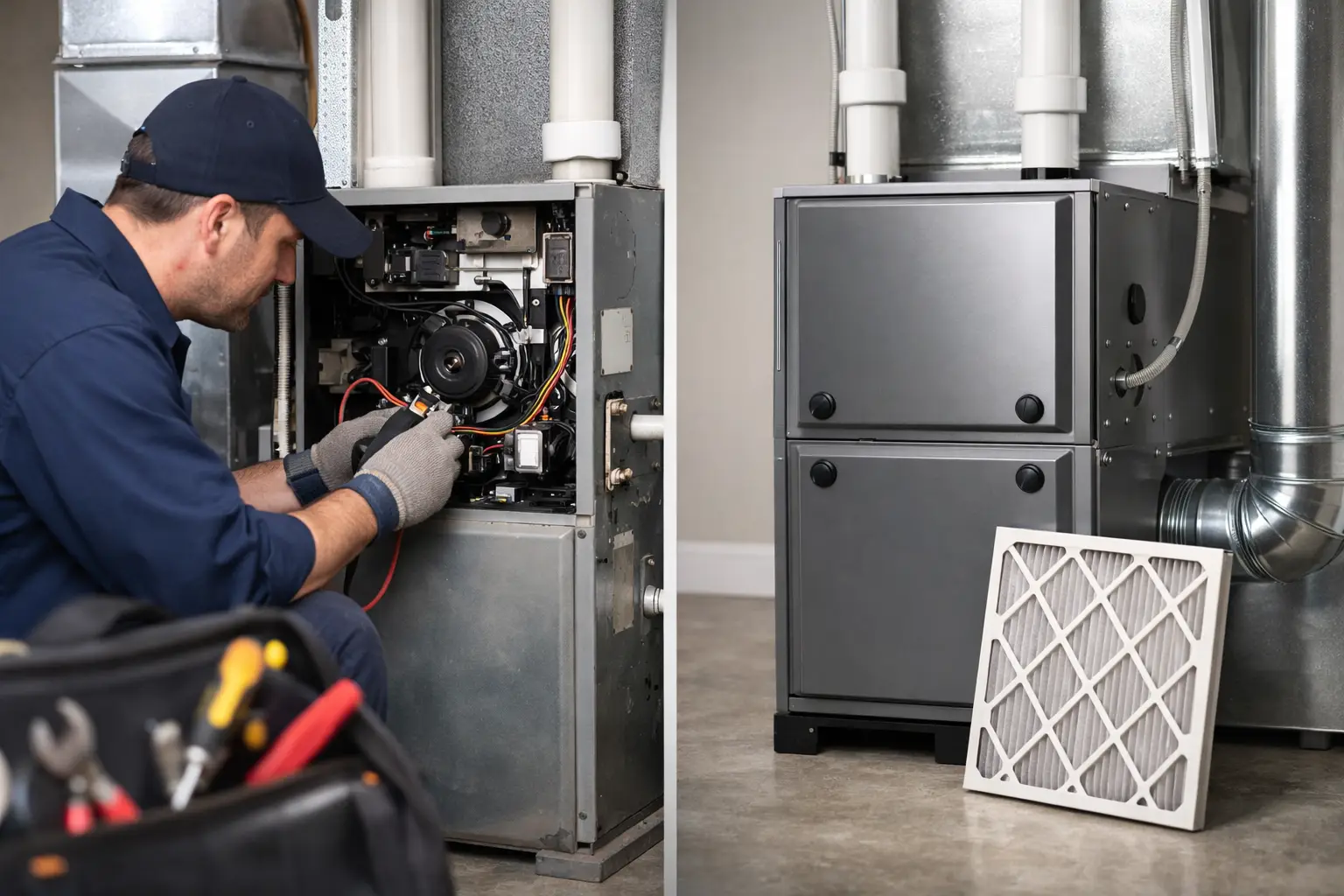
This decision should not be made from age alone. We have seen older furnaces that were still worth repairing and newer ones that had bigger underlying problems. A thorough inspection should look at heat exchanger condition, combustion performance, airflow, electrical components, venting, filter condition, and the overall health of the system.
That inspection should also answer a practical question: if you repair this today, what is likely next? Clear communication matters here. You should know whether the repair is expected to restore normal operation or whether it is simply a short-term measure to get through the season.
For homeowners in El Paso County, winter weather can make that timing especially important. If your furnace is already struggling before the coldest part of the season, waiting too long can turn a planned replacement into an emergency replacement.
Repair versus replacement for commercial properties
Commercial heating decisions often move on a different timeline. A small business, retail space, office, or multi-tenant property may have rooftop units, commercial furnaces, or boiler-linked systems where failure affects more people at once.
In those settings, replacement may be the better move earlier than it would be in a home. The reason is simple: lost comfort can affect business operations, tenant retention, and scheduling. If an older unit is causing recurring calls, replacement can create better cost control than chasing repairs across a heating season.
Still, not every commercial issue calls for replacement. If the system is structurally sound and the failure is isolated, repair may be the most efficient path. The key is having technicians who understand both immediate restoration and long-term planning.
The best choice is the one that fits the full picture
There is no one-size-fits-all answer to furnace repair versus replacement. A newer furnace with one failed part is often a repair job. An aging system with rising bills, uneven heat, safety concerns, or repeat breakdowns is often a replacement candidate.
What matters most is getting an honest recommendation based on condition, not pressure. Strong Heating and Cooling approaches that decision the same way customers do: fix what is worth fixing, replace what is no longer dependable, and be upfront about the cost either way.
If your furnace has started showing its age, the smartest next step is not guessing. It is getting a clear assessment so you can make a confident call before the next cold snap makes the decision for you.