When your furnace is running but the house still feels cold, airflow is often the real problem. If you want to know how to troubleshoot furnace airflow, start with the parts you can safely check yourself before assuming the furnace has failed. Weak airflow can come from something simple like a clogged filter, or from a larger issue that needs professional repair.
Airflow problems matter because your furnace depends on steady movement of air to heat your home evenly and operate safely. When that airflow drops, rooms can feel inconsistent, energy bills can rise, and the system can work harder than it should. In some cases, restricted airflow can even cause the furnace to overheat and shut down early.
How to troubleshoot furnace airflow without guessing
The best way to approach an airflow issue is step by step. Start with the easiest and lowest-risk checks first. That keeps you from overlooking a simple fix and helps you describe the problem clearly if you need a technician.
Before you begin, set the thermostat to heat and raise the temperature a few degrees so the furnace is actively calling for heat. Give the system a few minutes, then walk through the house and pay attention to what you feel at the supply vents. If some vents are pushing warm air strongly while others barely move any air, that points to an airflow restriction, duct issue, or balancing problem rather than a full system failure.
Check the air filter first
A dirty filter is one of the most common causes of weak furnace airflow. As dust and debris build up, the filter restricts return air moving into the system. That means less air reaches the blower, and less heated air makes it back into your rooms.
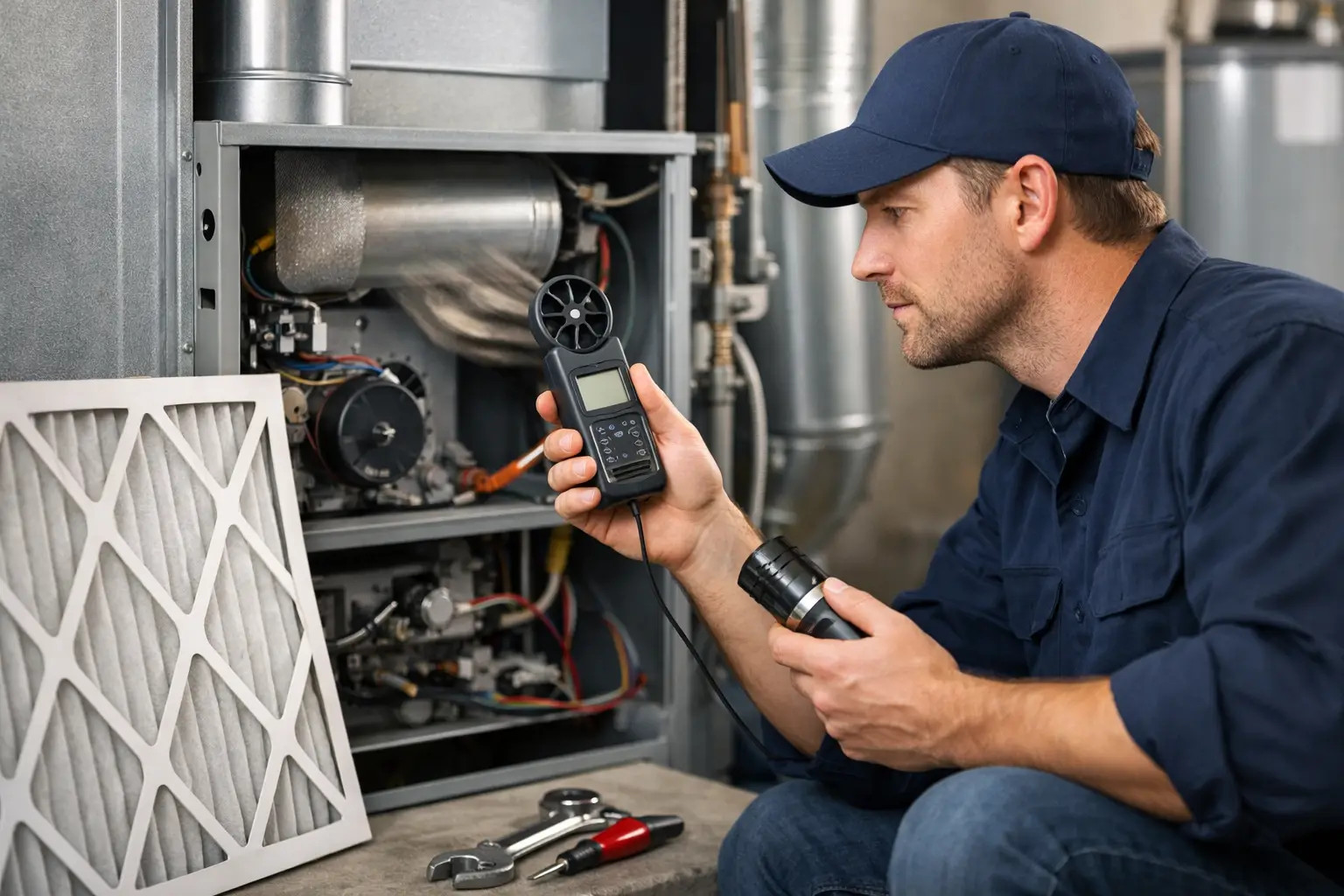
Remove the filter and inspect it in good light. If it looks gray, packed with dust, or visibly clogged, replace it. Make sure the new filter is the correct size and installed in the right direction, with the airflow arrow pointing toward the furnace. If you recently installed a very high-MERV filter and airflow dropped afterward, the filter may be too restrictive for your system. Cleaner is better, but only if the furnace is designed to handle that level of resistance.
Make sure vents and registers are open
Closed or blocked supply vents can reduce airflow throughout the system, not just in one room. Furniture, rugs, curtains, and even dust buildup can interfere more than people realize.
Walk room to room and confirm that supply registers are fully open and not covered. Then check the return vents as well. Return air needs a clear path back to the furnace. If a return grille is blocked by a couch, stacked boxes, or heavy dust, the whole system can struggle.
Look at the thermostat fan setting
Sometimes an airflow complaint is partly a thermostat issue. Check whether the fan is set to Auto or On. In Auto, the blower runs only when the furnace is heating. In On, it runs continuously.
If the fan runs in the On setting but airflow is still weak, that points more directly to a blower, duct, or filter issue. If the blower does not seem to respond properly at all, the problem may be electrical or mechanical rather than just restricted airflow.
Common signs of poor furnace airflow
Weak airflow is not always obvious at first. Some homeowners notice comfort problems before they notice what the vents are doing.
One common sign is uneven heating. A few rooms may feel comfortable while others stay chilly, especially rooms farther from the furnace. Another clue is a furnace that turns on and off too often. Restricted airflow can cause overheating inside the unit, which may trigger safety controls and shut the burner down early.
You may also hear changes in system sound. Whistling at vents can mean restricted airflow at the register or filter. Rattling or booming can point to duct issues or pressure imbalances. If the furnace cabinet feels unusually hot or the heat seems weaker than normal, poor airflow should be on the list of possible causes.
How to troubleshoot furnace airflow in the duct system
If the filter and vents look fine, the next likely area is the ductwork. Duct problems are harder to spot without tools, but there are still a few things you can check.
Start with visible ducts in basements, utility rooms, crawl spaces, or mechanical areas. Look for disconnected sections, crushed flexible ducts, loose insulation wrap, or dampers that may have been partially closed. A disconnected supply duct can dump heated air into an unconditioned space instead of sending it into the room it serves.
Pay attention to whether one section of the home has much weaker airflow than the rest. If the issue is limited to one branch of the duct system, the problem may be a local obstruction, damaged duct, or balancing issue. If weak airflow affects the whole property, the cause is more likely at the filter, blower, coil, or main trunk line.
For businesses or larger homes, duct design can also affect performance. Some airflow issues are not caused by a new breakdown at all. They come from undersized ductwork, poor balancing, or older system modifications that no longer match how the building is used.
The blower motor may be the issue
The blower is what moves heated air through the duct system. If it is dirty, worn, or failing, airflow will suffer even when the furnace is producing heat.
A blower problem might show up as weak airflow at every vent, unusual humming, squealing, or inconsistent fan operation. In some cases, the motor capacitor is failing. In others, the blower wheel is dirty and cannot move air efficiently. These are not ideal DIY repairs. Furnaces involve electrical components, moving parts, and combustion equipment, so this is usually the point where professional service makes the most sense.
If you remove the access panel only where the manufacturer allows homeowner filter access and notice excessive dust around the blower compartment, that alone can be a clue. Still, internal cleaning and motor testing should be left to a trained technician.
A dirty evaporator coil can affect heating airflow too
Many people associate the evaporator coil with air conditioning, but it can also affect furnace airflow because the air passes through that coil housing year-round in a forced-air system. If the coil is dirty, it creates resistance and reduces how much air can move across the furnace.
This is especially likely if filters have not been changed regularly. A dirty coil is not usually visible without opening parts of the system that should be serviced carefully. If your filter is clean, vents are open, and airflow still seems low across the whole house, coil restriction is one possibility a technician will check.
When airflow problems are really a maintenance issue
Sometimes the problem is not one failed part. It is a system that has slowly lost performance because routine maintenance has been skipped.
Furnaces work best when the filter is changed on schedule, the blower is cleaned when needed, and the system is inspected before peak heating season. That is especially true in places like Colorado, where winter demand can put a lot of strain on heating equipment. Small restrictions that seem manageable in mild weather can become a real comfort problem during a cold snap.
Regular maintenance also helps catch the issues that are easy to miss, such as early blower wear, dirty burners, loose duct connections, or safety switches reacting to overheating. If your furnace airflow problem keeps returning, maintenance is often the missing piece.
When to call a furnace professional
There is a practical line between homeowner troubleshooting and repair work that should not be delayed. If you have replaced the filter, confirmed vents are open, checked obvious duct access points, and still have weak airflow, it is time to bring in a professional.
You should also call for service sooner if the furnace is short cycling, making unusual noises, giving off a burning smell, or failing to keep the building warm. Those signs can point to restricted airflow, but they can also involve safety concerns or part failures that need proper testing.
For homeowners and property managers, the real goal is not just getting the furnace to run. It is getting steady, efficient, dependable heat without stressing the equipment. That often means fixing the airflow issue before it leads to bigger repairs.
If you are dealing with uneven heat or weak air from the vents, a clear diagnosis can save time and prevent wasted money on guesswork. Strong Heating and Cooling helps home and business owners identify the cause, explain the repair clearly, and get airflow moving the way it should. When your furnace sounds normal but comfort is still off, trust what the airflow is telling you.