

TL;DR:
- Most HVAC quotes conceal significant hidden costs, including equipment markups, permit fees, and electrical work, which can inflate final bills. Proper planning involves requesting itemized estimates, scheduling maintenance proactively, and understanding regional labor and regulatory factors. Transparent contractors, like Strongheatingandcooling, help homeowners manage expenses through clear communication and comprehensive pricing.
Most homeowners get a quote for HVAC work and assume the number they see is close to what they will pay. It rarely is. The hidden hvac cost drivers that inflate final bills are not always obvious from a standard estimate, and they catch even experienced property managers off guard. Understanding where these costs come from, how contractors structure their pricing, and what gets left out of initial quotes gives you real control over your HVAC budget. This article breaks down the most common and costly surprises so you can plan ahead instead of reacting after the fact.
Table of Contents
- Key takeaways
- 1. Hidden HVAC cost drivers: equipment markups and real vs. quoted prices
- 2. Deferred maintenance and emergency repair premiums
- 3. Scope exclusions and surprise change orders
- 4. System design complexity, ductwork, and access challenges
- 5. Timing, labor market, and regulatory compliance costs
- 6. Energy efficiency impacts on long-term costs
- 7. Contractor selection and the true cost of the lowest bid
- My perspective on hidden HVAC costs
- How Strongheatingandcooling helps you avoid surprise HVAC bills
- FAQ
Key takeaways
| Point | Details |
|---|---|
| Equipment markups are substantial | Contractors routinely mark up equipment 20% to 100%, so the price you see rarely reflects actual equipment cost. |
| Deferred maintenance costs more | Skipping routine service increases failure risk and triggers emergency labor rates up to 3x the standard price. |
| Quotes often exclude key line items | Permits, disposal, line set replacement, and electrical work can add over $1,000 to a project not covered in the base quote. |
| System complexity drives labor costs | Ductwork condition, zoning, and poor access points significantly raise both installation and future repair expenses. |
| Timing affects what you pay | Scheduling work during shoulder seasons and avoiding peak demand periods reduces labor costs and contractor premiums. |
1. Hidden HVAC cost drivers: equipment markups and real vs. quoted prices
When a contractor gives you a quote for a new furnace or air conditioner, the equipment line item often looks like a single number. What that number rarely tells you is how far it sits above the actual wholesale price the contractor paid.
Contractors commonly apply a 20% to 100% markup on HVAC equipment, using overhead, warranty administration, and profit margin to justify the increase. In practice, a unit that wholesales between $3,200 and $4,500 can appear on your quote at anywhere from $6,450 to $13,000. That gap is not fraud. It is a standard industry practice, but it becomes a problem when you do not know it exists.
The markup structure flows through a supply chain. Manufacturers sell to distributors, distributors sell to contractors, and contractors sell to you. Each layer adds cost. The contractor’s markup covers their storage, truck stock, warranty handling, and business overhead, which are all legitimate expenses. The issue is that most quotes bundle equipment and labor into a single total, making it nearly impossible to evaluate whether the equipment portion is reasonable.
You can address this by requesting an itemized quote that separates equipment cost from labor, permits, and materials. Some contractors will provide this without hesitation. Others will resist, which itself tells you something. Comparing the quoted equipment price against published retail prices for the same model gives you a baseline for negotiation.
Pro Tip: Ask your contractor for the model number of the equipment they plan to install before signing anything. Look up that specific model online to understand the general price range. This one step gives you enough context to have an informed conversation about the equipment portion of your quote.
2. Deferred maintenance and emergency repair premiums
Skipping annual HVAC maintenance feels like a reasonable way to save money in the short term. Over time, it becomes one of the most expensive decisions a homeowner or property manager can make.
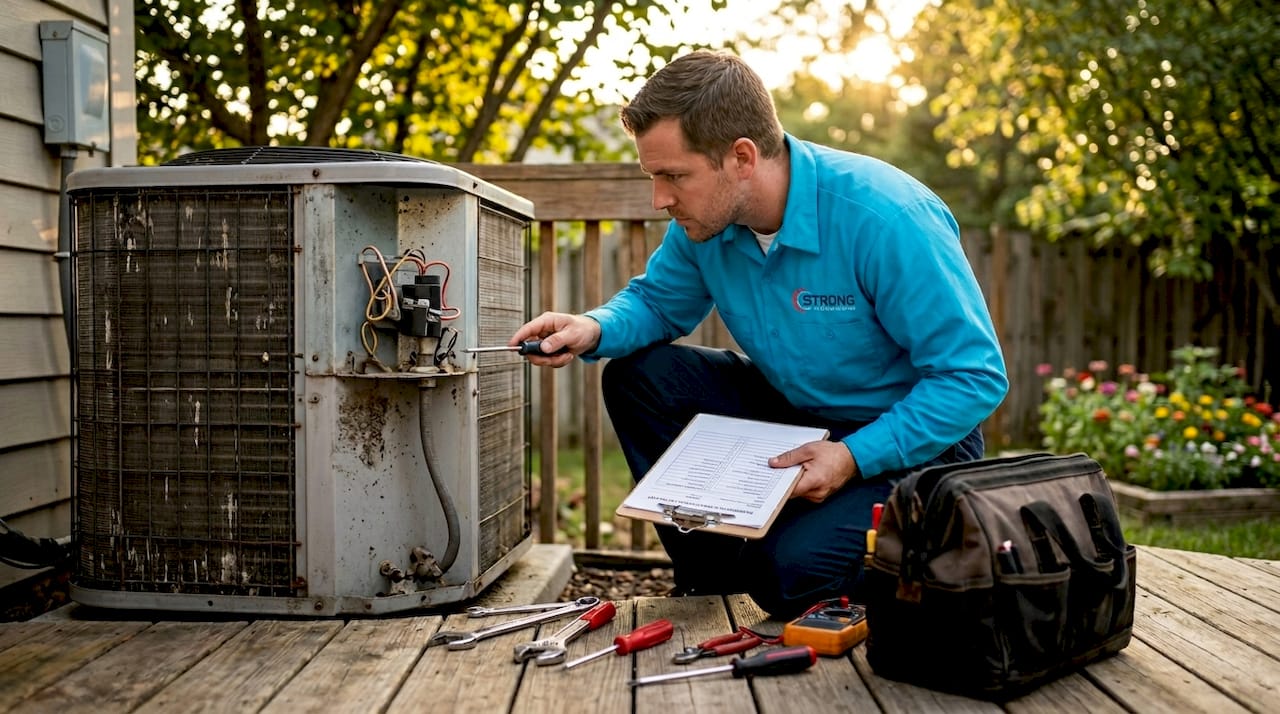
Deferred maintenance leads to significantly higher system failure risk, with affected systems showing up to 15% energy efficiency loss and reduced equipment lifespan. When a system fails because of neglected service, the repair itself is rarely the only cost. The timing of that failure is what creates the real financial damage.
Emergency HVAC services after hours or on holidays cost between 1.5x and 3x more than standard labor rates. Emergency diagnostic fees alone run $150 to $500, compared to $70 to $150 during normal business hours. In major metro areas, emergency labor rates can reach $600 per hour during peak periods. A repair that would cost $400 on a Tuesday afternoon can easily become a $1,200 bill on a Saturday night in July.
The most common deferred maintenance issues that lead to these situations include dirty or clogged air filters restricting airflow and straining the blower motor, neglected condensate drain lines that back up and trigger system shutoffs, worn capacitors and contactors that fail without warning during peak cooling season, and dirty evaporator or condenser coils that force the compressor to work harder than it should.
Property managers overseeing multiple units face compounded risk. One system failure during a heat wave can mean multiple emergency calls across a building, each carrying those premium labor rates. Scheduling routine HVAC maintenance twice a year costs a fraction of a single emergency call and dramatically reduces the odds of one happening.
Pro Tip: Set calendar reminders for HVAC service in spring and fall, before the seasons when systems work hardest. Pre-season appointments are easier to schedule, often less expensive, and catch problems before they become failures.
3. Scope exclusions and surprise change orders
A low quote is not always a good quote. One of the most reliable hidden costs in HVAC work comes from what contractors leave out of the initial bid, not what they include.
Permits, disposal fees, line set replacement, thermostat upgrades, and electrical work are among the most commonly excluded items from base HVAC quotes. Individually, each seems minor. Together, they can add over $1,000 to your final bill.
Here is what each of those items typically costs when they appear as a change order after work has already started:
- Permit fees range from $50 to $450 depending on your municipality. Some contractors pull permits as a standard practice. Others treat it as optional unless you ask.
- Old equipment disposal runs $75 to $200. Refrigerant recovery and proper disposal of the old unit are required by law, but not always included in quotes.
- Line set replacement costs $200 to $600. If your existing refrigerant lines are corroded, improperly sized, or too short for the new unit’s location, they need to be replaced. This rarely appears in a base quote.
- Thermostat upgrades add $50 to $250. Many modern high-efficiency systems require a compatible thermostat. If yours is older, the upgrade is not optional, but it may not be listed upfront.
- Electrical work varies widely. If your new system requires a different circuit, breaker, or disconnect box, that work falls outside a standard HVAC quote and requires a licensed electrician.
The practical defense against these surprises is a detailed scope of work before you sign a contract. Ask the contractor to list every task, material, and fee that could appear on the final invoice. Unaccounted line items like refrigerant recovery and electrical upgrades routinely cause change orders, and an itemized scope prevents most of them.
4. System design complexity, ductwork, and access challenges
Two homes with identical square footage can have dramatically different HVAC installation costs. The difference usually comes down to how the system needs to be designed, how the ductwork is configured, and how easy it is for a technician to reach the equipment.
Home size, zoning requirements, and duct layout all affect both material and labor costs in ways that a simple per-ton pricing estimate will not capture. A single-zone system in a straightforward ranch-style home costs far less to install and maintain than a multi-zone system in a two-story home with a finished basement and tight mechanical room access.
Duct condition is one of the most overlooked HVAC pricing factors. Leaky ducts can waste 20% to 30% of conditioned air before it reaches living spaces, which means your new high-efficiency system performs like a mid-grade one from day one. Sealing, resizing, or replacing ductwork adds cost to any installation project, but skipping it means paying higher energy bills for the life of the system.
Commissioning services, specifically the Test, Adjust, and Balance process, are another cost that often gets cut from proposals to lower the bid price. Commissioning verifies that the system is operating at its rated efficiency, that airflow is balanced across all zones, and that the equipment is performing as designed. Skipping commissioning leads to inefficient operation and higher long-term energy and maintenance costs. The upfront cost is typically 5% to 10% of the project total, and it pays back through lower utility bills and fewer service calls.
Access challenges add another layer of unforeseen HVAC charges. Equipment installed in a crawl space, attic with limited clearance, or mechanical room that requires disassembly to reach will cost more to service every single time a technician visits. If you are replacing equipment, consider whether the new unit can be positioned for easier future access. That decision affects your maintenance costs for the next 15 to 20 years.
5. Timing, labor market, and regulatory compliance costs
When you schedule HVAC work matters almost as much as what work you need done. The same job can cost noticeably more or less depending on the time of year, the state of the local labor market, and the regulatory requirements that apply to your system.
Peak season demand drives up contractor rates because technicians are fully booked and overtime becomes the norm. In Colorado Springs, that means late spring through summer for cooling systems and the first cold snaps of fall for heating. Contractors are not price gouging during these periods. They are simply reflecting real supply and demand. The practical takeaway is that scheduling replacements or non-urgent repairs during shoulder seasons, late winter for cooling and early fall for heating, typically results in better pricing and faster scheduling.
Regional labor rate variation is another factor that rarely appears in HVAC pricing discussions. Labor costs in a rural area can be 30% to 40% lower than in a dense metro market, and even within a metro area, rates vary by contractor size, specialization, and demand. Getting three quotes is not just about finding the lowest number. It gives you a realistic picture of what labor actually costs in your specific market.
Regulatory compliance adds costs that are non-negotiable. Permit fees and inspections are required for most HVAC installations and replacements, and they exist to protect you. EPA refrigerant handling regulations require certified technicians to recover and properly dispose of refrigerants, which adds both time and cost to any job involving older systems. Units over 10 years old often use refrigerants that are now restricted or phased out, making repairs on aging systems more expensive due to limited refrigerant availability and higher handling costs.
Pro Tip: If your system is approaching 10 years old and uses R-22 refrigerant, get a replacement quote now rather than waiting for a failure. The cost of R-22 has increased significantly due to phase-out regulations, and a repair that requires adding refrigerant can cost more than you expect.
6. Energy efficiency impacts on long-term costs
The SEER rating on a new air conditioner or the AFUE rating on a furnace looks like a simple efficiency number. What it actually represents is a long-term cost commitment that plays out over the life of the system.
A higher-efficiency unit costs more upfront. That is the visible cost. The hidden cost comparison is what happens over 15 years of operation. A system with a 14 SEER rating running in a Colorado Springs home will consume meaningfully more electricity than a 20 SEER unit doing the same work. The difference in monthly utility costs can range from $20 to $80 depending on usage patterns and local electricity rates. Over 15 years, that gap can exceed the entire cost difference between the two units.
The energy efficiency impacts on your budget extend beyond the equipment rating itself. Duct leakage, as mentioned earlier, erodes efficiency regardless of what the equipment is rated. An improperly sized system, one that is too large for the space, short-cycles repeatedly and never reaches steady-state efficiency. Both situations result in higher energy bills that homeowners often attribute to rising utility rates rather than to the HVAC system itself.
Utility rebates and tax credits are another area where homeowners leave money on the table. Many high-efficiency systems qualify for federal tax credits and local utility rebates that offset the HVAC upgrade costs significantly. These incentives are not automatically applied. You need to ask about them, verify eligibility, and in some cases file paperwork. A contractor who does not mention available rebates is not necessarily being dishonest, but they are leaving you with an incomplete picture of the real cost of your options.
7. Contractor selection and the true cost of the lowest bid
Choosing the lowest quote is a natural instinct when facing a large HVAC expense. It is also one of the most reliable ways to encounter unexpected HVAC expenses later in the project.
The lowest bid is almost always low for a reason. Sometimes that reason is a contractor who operates lean and passes savings to customers. More often, it reflects missing scope items, lower-grade equipment, unlicensed subcontractors, or a plan to recover margin through change orders once the job is underway. By the time those additions appear, you are already committed.
Evaluating bids requires looking beyond the total number. Compare what each quote actually includes. Does it cover permits? Disposal? Commissioning? A warranty on both parts and labor? A bid that includes all of these items at a higher total price may cost less than a lower bid that excludes them. The HVAC pricing factors that determine real value are rarely visible in a single-line quote.
Contractor licensing, insurance, and manufacturer certifications also affect your costs in ways that are not immediately obvious. An unlicensed contractor may offer lower prices, but their work will not pass inspection, may void your equipment warranty, and leaves you with no recourse if something goes wrong. Verifying that a contractor is licensed and insured before signing a contract is not a formality. It is financial protection.
My perspective on hidden HVAC costs
I have worked with enough homeowners and property managers over the years to recognize a consistent pattern. The frustration people feel after getting a surprise HVAC bill is almost never about the money alone. It is about feeling like they did not have the information they needed to make a good decision.
In my experience, the contractors who provide itemized, transparent quotes do not lose business because of it. They earn trust. Customers who understand what they are paying for and why are far more likely to call back, refer friends, and stay loyal. Opacity in pricing does not protect contractors. It creates the kind of distrust that drives customers to shop on price alone, which hurts everyone.
What I have seen consistently is that deferred maintenance leads to the most painful bills. A homeowner who skips two or three years of service to save $300 ends up spending $1,500 on an emergency repair that a $150 tune-up would have prevented. The math is not complicated, but it requires thinking past the immediate expense.
My honest advice is to treat your HVAC system the way you treat your car. You would not skip oil changes and hope nothing breaks. The same logic applies here. Schedule service, ask for itemized quotes, and plan replacements before failures force your hand. Knowledge is the most effective cost control tool available to you.
— Owner
How Strongheatingandcooling helps you avoid surprise HVAC bills
At Strongheatingandcooling, we built our business on the belief that homeowners and property managers deserve honest pricing and clear communication from the first call to the final invoice. Surprise charges and vague quotes are not how we operate.

When you work with us, you get itemized estimates that break down equipment, labor, permits, and any additional materials so you know exactly what you are paying for and why. Our cooling services and heating offerings cover everything from routine maintenance to full system replacement, with transparent pricing at every step. We handle permits, refrigerant disposal, and regulatory compliance so nothing gets left off the quote and nothing shows up unexpectedly on your final bill. Serving Colorado Springs and surrounding communities, our team brings over 40 years of combined experience to every job. Reach out to schedule a maintenance visit, request a quote, or ask about our air conditioner services before the next peak season arrives.
FAQ
What are the most common hidden costs in HVAC quotes?
Permit fees, old equipment disposal, line set replacement, thermostat upgrades, and electrical work are the items most frequently left out of base quotes, and they can add over $1,000 to a project’s final cost.
How much more does emergency HVAC service cost?
Emergency HVAC repairs after hours or on holidays typically cost 1.5x to 3x more than standard rates, with diagnostic fees ranging from $150 to $500 compared to $70 to $150 during normal hours.
Does skipping HVAC maintenance really increase costs?
Yes. Systems with deferred maintenance show up to 15% efficiency loss and significantly higher failure risk, which means higher energy bills and a much greater chance of an expensive emergency repair.
When is the best time to schedule HVAC replacement to save money?
Scheduling replacement during shoulder seasons, late winter for cooling systems and early fall for heating, avoids peak demand periods when labor rates rise and contractor availability tightens.
How do I know if a contractor’s equipment markup is reasonable?
Request the model number of the proposed equipment and compare it to published retail prices. Equipment markups of 20% to 100% are common, so an itemized quote that separates equipment from labor gives you the clearest picture of where your money is going.


